The Last Glyph: documenting an ancient pictographic system
Flag 61 · June 2026
A two-week stay with Dongba priests and artisans in Yunnan to assess whether the world’s last living pictographic writing system survives under mass tourism and modernization.
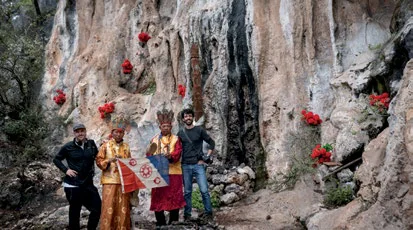
In June 2026 the expedition travelled into remote valleys of Yunnan Province, China, concentrating on the sacred enclave of Baidi in the municipality of Sanba (Shangri-La), at about 2,500 metres on the alpine borderlands toward Tibet. This region is the spiritual and historical origin of the Naxi people and the cradle of Dongba culture, whose priests keep the last active, working pictographic writing system on Earth, inscribed by UNESCO on its Memory of the World Register in 2003.
The fieldwork was designed to follow the path of Joseph Rock, the Austrian-American explorer, geographer and botanist who studied the Naxi a century ago and called the region a labyrinth of mountains and canyons. Its isolation protected the priests’ traditions, but globalization and modernization now press on them, with big infrastructure investment turning Yunnan into a mass-tourism destination. In 2025 the province received an estimated 782 million visitors, about 83 million of them in the Lijiang area.
The team set out to evaluate and document the current state and prospects of the writing system. Their working idea was that to count as living, the Dongba script, called serjlv serjluq in the Naxi language, must still serve as an active tool of daily community use, not a fossilized record or a tourist product. They also suspected friction among authentic priests over the commercial exploitation and staged authenticity seen in Lijiang.
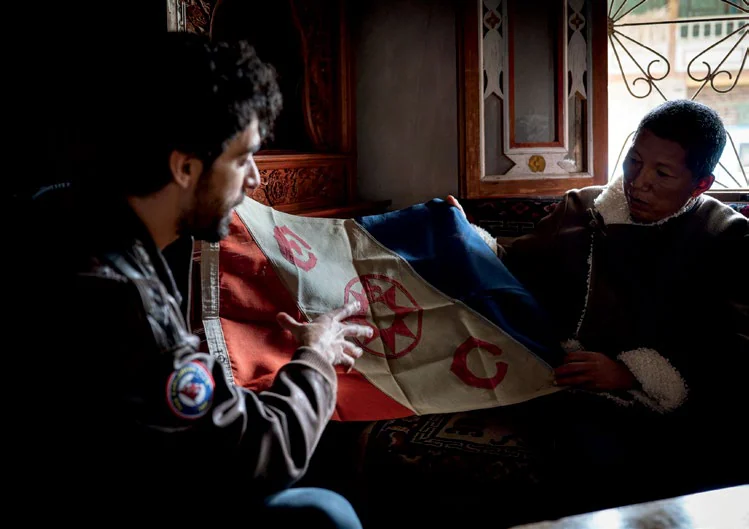
After two weeks of ethnographic immersion and structured interviews with traditional priests and artisans who make ritual drums and handmade paper, the team concluded that the script is extremely fragile yet still alive through a very small line of practitioners. The Spain Chapter’s report adds that symbols lose meaning when cut from their spiritual setting, that a new generation is keen to learn, and that priest He Guiquan turned out to belong to the family that hosted Joseph Rock a century ago.
People
- Javier Corso · MI’26 · Flag carrier and expedition leader
- Guillem Trius · Filmmaker
Places
- Baidi, Sanba (Shangri-La), Yunnan — Coarse. The Log places the sacred enclave of Baidi within the municipality of Sanba, at about 2,500 metres.
- Lijiang, Yunnan — Named as the urban centre of the tourism the team assessed; listed in the brief entry.
Source notes
Flag 61 is also printed in this issue against other expeditions (Aw, Krueger, Philips), so the number alone does not identify it. The return report is dated June 2026, only a month before this issue’s date.
Sources
- The Explorers Log, Summer 2026, p. 28 · Flag Returns: Return of Flag Nº 61
Corso reports the June 2026 expedition to Baidi, its aims, working hypothesis and the findings on the state of Dongba writing.
- The Explorers Log, Summer 2026, p. 36 · Compass Points: Spain Chapter
Says the expedition carried Flag 61 and the Spain Chapter’s Flag Nº 1 and notes the discovery of He Guiquan’s family link to Joseph Rock.
Photographs